Informational
Affil vs PerformLine: Best AI Affiliate Compliance & Monitoring Tools for 2025
Affil.ai
January 3, 2026
6
MIN READ

TL;DR: Modern brands need a compliance solution that understands context, adapts to their workflow, and scales as their affiliate programs grow. Affil delivers this by leveraging AI’s most up-to-date capabilities and offering flexibility for any existing compliance workflow. Affil ultimately offers the more adaptive, modern, and comprehensive compliance solution.
Affil.ai and Performline both provide monitoring solutions for brands needing close oversight of marketing and advertising content. Reasons for this are twofold, ensuring regulatory compliance and reducing risk, while also preserving key brand messaging and overall brand integrity. These requirements are shaped by laws such as UDAAP, TILA/Reg Z, FDIC’s Part 328 Rule, and state-level consumer-protection rules such as the California Consumer Financial Protection Law (CCFPL). Where the two solutions diverge is in how they use AI, how well they adapt to each brand’s compliance workflows, and which capabilities they actually deliver to marketing, legal, and compliance teams to solve their pain points.
Affil was built to be easily integrated into any compliance workflow. It applies a nuanced, comprehensive AI solution to surface material risks while reducing false positives and simplifying remediation. It further offers features that extend past compliance, giving marketing and analytics teams powerful insights for growth.
Performline, in contrast, is designed for large compliance departments and relies on stricter, rules‑based logic for its AI solution. Its pre‑built rule libraries can generate a high volume of irrelevant findings that require “fine-tuning” to fit each brand’s compliance guidelines. This approach can be more labor-intensive to manage as it increases review volume.
The rest of this article will break down the main differences between the platforms and make the case for why Affil rises above the competition.
Affil and Performline both target brands in heavily regulated industries that face strict marketing and advertising compliance requirements. Examples include banks, BaaS (Banking-as-aservice) providers, fintech companies, and BNPL lenders. In particular, younger industries such as BaaS providers and fintech companies have recently been the subject of regulatory focus as seen in the joint statement issued by the FDIC, Federal Reserve, and OCC in 2024.
The primary distinction between Affil and Performline lies in how each leverages AI to improve the marketing compliance process. Affil combines and orchestrates multiple AI capabilities into its compliance solution and offers a more robust solution that can adapt to any brand’s compliance workflow, no matter what the structure or existing steps are.
Performline in contrast was created for centralized compliance departments and is less suited to brands where marketing and legal share compliance responsibilities or follow more flexible, marketing-led review workflows.
Performline primarily incorporates rules-based detection when implementing AI technology to its platform. Rules-based monitoring is limited in that it doesn’t truly solve the users’ compliance burdens as it produces a slew of false positives.
The results are similar to Example 1 below, where the AI flags perfectly acceptable content just because it technically matches a rule, even when the actual risk is nonexistent or low.
“When a customer tries to pay with an inactive card, the system will automatically block the attempt.”
Let’s say we want the AI to flag all mentions of the fintech company Block. Rules-based monitoring solutions will flag this quote as a “product detection,” unable to distinguish whether the word “block” is referring to the verb (e.g. to *block* a transaction), the noun (e.g. a *block* of data), or the proper name of a fintech company, Block.
In order to actually save customers’ time and be easy to use, a compliance solution must properly utilize contextual analysis to prevent false positive outputs. Affil not only raises less false alarms but is also able to produce customized, concise explanations for easier remediation.
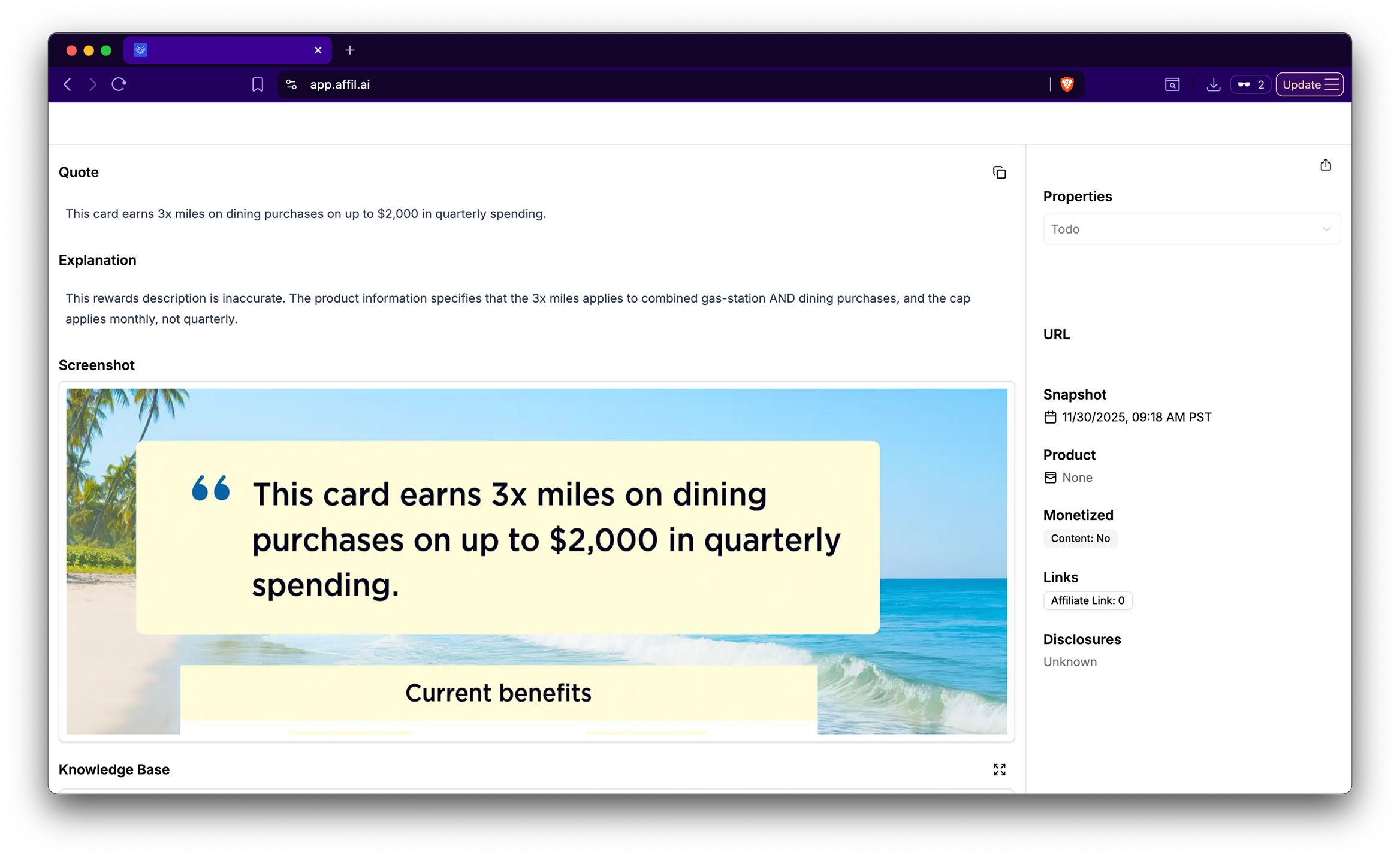
“This card earns 3x miles on dining purchases on up to $2,000 in quarterly spending.”
Let’s say "this card" earns up to 3x miles on gas stations and dining purchases on up to $2,000 in combined purchases each month.
In order for the affiliate, content creator, or marketing team to remediate easily, the generated explanation must go beyond mere categorization of the compliance issue. Contextual AI analysis makes a meaningful difference here. Below is a sample Affil explanation:
Explanation: This rewards description is inaccurate. The product information specifies that the 3x miles applies to combined gas-station AND dining purchases, and the cap applies monthly, not quarterly.
This level of specificity prevents teams from wasting time deciphering vague or incomplete feedback.
Another key differentiator is Affil’s precision in knowing what not to flag. A sophisticated compliance solution isn’t concerned about catching everything, but is also sensitive to avoiding irrelevant false alarms for accurate content discovery.
Consider a situation where a product name or financial trigger term appears in a website’s sidebar, header, or navigation menu, instead of a main article’s text. Affil’s AI knows detecting a product in this instance would have little compliance risk on its own, as it doesn’t include any written content about the brand or product. The solution knows to not raise issues in these peripheral elements, and stops the user from reviewing web pages that have no relevant compliance concerns.
This “selective scrutiny” helps reduce the number of actually relevant marketing content for the brand to review and communicate to the merchant for remediation.
The importance of documentation and record keeping cannot be overstated in the realm of compliance. When thoroughly documented, the insight an audit trail provides can eliminate guesswork and simplify workflows across all teams involved in the marketing campaign. Some examples:
As such, marketing compliance solutions typically include some kind of audit trail feature. Performline, for example, boasts record keeping as one of its capabilities. Performline’s limitations for this key feature lie in the apparatus they use for record keeping: screenshots.
In essence:
A screenshot captures the visual representation of what was displayed on a marketing campaign at a given time. In other words, a screenshot gives you a photo of the book, but not the contents of the book itself. For audit trails, full insights are necessary.
A screenshot doesn’t provide info on:
Snapshots, by contrast, capture the exhaustive digital footprint of a particular marketing campaign at a moment in time. They preserve not just the visual appearance, but the hidden elements, and functional details that compliance and marketing teams need.
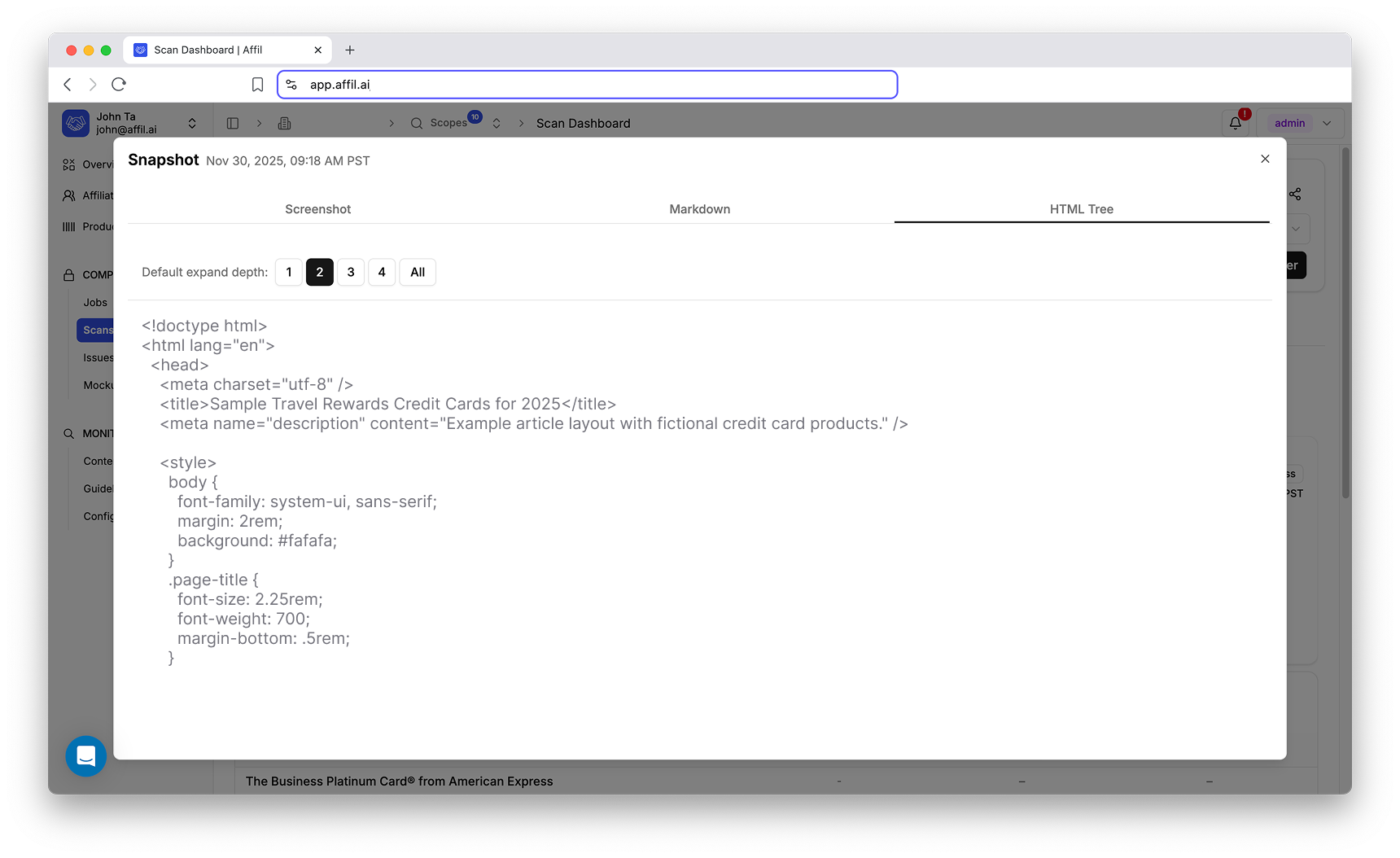
For example, a snapshot can reveal that a product’s CTA actually linked to a different product, catching a bait-and-switch tactic that a screenshot couldn't detect. This level of documentation transforms audit trails from visual references into defensible evidence that can withstand regulatory review.
Affil leverages snapshot technology to capture complete audit trails, going beyond the limitations of basic screenshots.
After speaking with customers, Affil found that affiliates and brands were relying on scattered emails and wordy/dense PDFs to share proprietary brand and product information. To tackle this, Affil built a centralized resource center into the platform that affiliates can reference directly when creating content. In this central hub, affiliates and content creators find up-to-date marketing guidelines, best practices, and compliance requirements, in one convenient place. This keeps everyone aligned on the latest info and means affiliates no longer have to dig through inboxes or lengthy documents.
By making compliance guidelines easy for affiliates to find and follow, affiliates can focus solely on creating quality content. As a result, both brands and affiliates spend less time on remediation and reviews. Performline, in contrast, does not offer an equivalent centralized resource. Affil’s solution scales compliance through prevention, not just remediation.
In addition to compliance monitoring, Affil provides link analytics that provide valuable insights for marketing campaign performance. Every link placed in affiliate or brand content can be tracked and analyzed.
Performline doesn’t provide any comparable link-tracking capabilities or tools.
Affil understands that every brand has core messaging elements such as required product features, approved benefit language, or key value propositions that they want monitored in affiliate and partner content. These elements shape how potential customers are viewing the brand’s product, so consistent and accurate representation is essential for preserving the brand’s message.
For example, if a credit card product includes a valuable trip-protection benefit, Affil’s feature-detection solution can automatically scan affiliate content to confirm that (1) benefit is clearly mentioned, (2) how many times it's mentioned, and (3) how it’s mentioned.
Instead of manually checking web pages and embedded dropdowns for required phrases or brand claims, Affil can detect exactly what was included, what was missing, and where inconsistencies show up.
Performline does not include this detection feature.
One of Affil’s disadvantages is that it does not monitor the entire internet for brand mentions. There are plenty of tools out there, including PerformLine, that do this.
Part of the reason is that Affil invests a lot of resources into ensuring accuracy and reducing false positives when it comes to correctly identifying products. So, as long as you can give Affil the websites it needs to monitor, it will crawl the entire site to find all relevant information and context. Affil won't be able to scour the internet to find everything relevant by itself, but just needs a bit of top down support so that it can find what it needs.
One area where Affil shines is its multichannel capabilities. Affil can effectively scrape websites, YouTube, Instagram, and TikTok. For social media content, the AI engine will then transcribe the content and store everything in highly detailed snapshots for compliance logging.
Affil is positioned as the compliance solution for today’s marketing, legal, and compliance teams. Its capabilities reflect a next-generation approach that simplifies the entire compliance and brand monitoring workflow by saving time and effort for both the brand and affiliate.
Performline lacks implementation of modern AI technology and continues to depend on rigid rule-based monitoring, producing large amounts of false positives. Overall, Affil is the more adaptive, accurate, and comprehensive compliance solution.
Affil’s adaptability also makes it particularly valuable for fast-evolving financial sectors such as crypto, digital assets, neobanking, and online investing platforms. These are all industries where regulations shift often, and accurate marketing claims are critical to maintaining consumer trust.
1. Why does contextual analysis matter for compliance?
An AI solution that is capable of contextual analysis can dramatically reduce false positives, improve issue detection accuracy, and provide clear explanations for remediation. This saves teams time that would otherwise be spent sorting through irrelevant issues.
2. What makes Affil better suited for today’s compliance efforts?
Affil can adapt to any brand’s compliance workflow, whether it’s marketing-led, legal-led, or within a shared scope. Performline was built for more centralized, traditional compliance departments, which creates a misfit for some brands’ existing workflows.
3. How does Affil help reduce manual review volume?
Affil’s solution can ignore irrelevant elements and focus only on material compliance risks. Additionally, it learns from past issues and produces clear, concise explanations, leading to teams spending less time sorting through hallucinations and drafting remediations.
4. What are Affil’s unique capabilities that Performline lacks?
Affil provides link analytics, feature detection, selective exclusion, explanations conducive for remediation, multiple snapshots, and a custom resource hub, amongst many other modern capabilities that Performline does not offer.
5. What platforms can Affil monitor?
Affil can monitor affiliate content across all platforms, as long as we know who the affiliates are. Once the brand’s affiliates are identified, we can scan content across the affiliates’ emails, newsletters, web pages, social media, Youtube, etc.